
Oglethorpe Criminal Case Files
Criminal court records in Oglethorpe County focus on the case file, not just the arrest. Superior Court is the general-jurisdiction trial court and handles felony criminal cases. The Clerk of Superior Court keeps the Superior Court criminal file and related docket entries. The Clerk's office is at 111 West Main Street in Lexington, and the Clerk site links to Case Search, Court Calendars, Jury Info, Legal Notices, and Legal Forms.
Magistrate Court can be involved before or near the start of a criminal case because it expressly lists issuance of warrants. It can also be involved in first-appearance or bond-related local process, depending on the matter. Once a felony prosecution is filed, the Superior Court criminal file becomes the main court record. For a closer look at the arrest-to-charge path, use arrest records and court charges. For broader civil, probate, traffic, and court-access topics, use Oglethorpe court records.
The Northern Judicial Circuit District Attorney prosecutes criminal cases for Elbert, Franklin, Hart, Madison, and Oglethorpe counties. The DA is D. Parks White. Oglethorpe County's DA contact uses 45 Forest Ave., Elberton, Georgia, with mailing at P.O. Box 247, Elberton, and phone 706-283-1716. That regional office location matters because a case can be filed in Oglethorpe County while prosecution support comes through a circuit office outside Lexington.
Search Oglethorpe Criminal Records
The official Clerk case-search link points to WebCaseManagement, but research could not inspect its live search fields because the fetch encountered a redirect loop. Try that link in a live browser first for Superior Court criminal cases. If it does not load, if the case is older, if the result is incomplete, or if a certified copy is needed, use the Clerk of Superior Court directly by counter, mail, phone, or fax.
- Confirm that the case is a court case, not just a booking, tip, or custody record.
- Try the Clerk's Case Search link for Superior Court criminal cases and check Court Calendars for hearing information.
- Search by the fields available in the live portal, then record the case number and party name exactly as shown.
- Read the docket for filings, arraignment, motions, plea, trial, disposition, sentence, and probation activity.
- Request a certified copy from the Clerk of Superior Court when a legal or official copy is required.
State and agency systems can help, but they do not replace the court file. The Sheriff's booking search can show current confinements and recent bookings. GDC is for sentenced state prisoners. The GBI record-restriction resource explains Georgia restriction rules. DDS records show driver history. A criminal court record remains the file kept by the court after prosecution enters the court system.
Oglethorpe Criminal Case Flow
A criminal court record grows in stages. Early entries may come from warrants, arrest, bond, accusation, or indictment activity. The case then moves through arraignment, motions, hearings, plea talks, trial settings, disposition, and sentencing. Not every case reaches trial. Many cases resolve by plea, dismissal, reduction, nolle prosequi, or other disposition. The docket is the timeline that ties those events together.
Case flow: Charges Filed › Arraignment › Pretrial and Motions › Plea or Trial › Disposition › Sentencing
| Stage | What Happens |
|---|---|
| Charges Filed | The prosecutor files or proceeds on a charging document, such as an accusation or indictment, and the clerk opens or updates the criminal case file. |
| Arraignment | The defendant is advised of the charge and enters a plea, often guilty, not guilty, or another allowed plea. |
| Pretrial and Motions | Attorneys file motions, request hearings, address evidence, negotiate, and prepare for plea or trial. |
| Plea or Trial | The case resolves by plea or proceeds to trial, where a verdict or other result is entered. |
| Disposition | The docket reflects the outcome of each count or case, such as guilty, dismissed, acquitted, nolle prosequi, or reduced. |
| Sentencing | The court enters punishment terms, which may include jail, prison, probation, fines, costs, restitution, or special conditions. |
Note: A booking charge can change before the prosecutor files the formal court charge.
What Oglethorpe Criminal Records Show
Oglethorpe County criminal court records can show the history of a charge from filing through sentence. They may include the charge description, statute, offense level, arresting agency, bond, warrant number, accusation or indictment count, motions, orders, plea, verdict, sentence, probation terms, and financial obligations. The exact field set depends on the live docket, the case type, and any redaction or restriction.
| Field | What It Shows |
|---|---|
| Case Number | The court's tracking number. No live Oglethorpe criminal case-number format was captured, so do not assume a sample format. |
| Defendant | The person charged in the criminal case, subject to redaction rules for protected data. |
| Charges | Charge descriptions, counts, offense levels, statutes, or amendments when shown by the docket or filings. |
| Bond | Security, release terms, bond amount, no-bond status, or related order when present. |
| Plea | The defendant's formal response, such as guilty, not guilty, nolo, or another plea recognized by the court. |
| Disposition | The result of the case or count, including guilty, dismissed, acquitted, nolle prosequi, reduced, or transferred where applicable. |
| Sentence | Punishment terms such as confinement, probation, fines, court costs, restitution, or special conditions. |
| Docket Entries | Filings and events, including arraignment, motions, hearings, orders, continuances, trial, plea, sentencing, and revocation entries. |
Some criminal case files also include probation revocation activity, warrants, sentencing sheets, exhibits, or financial entries. Public copies may omit juvenile names, medical data, Social Security numbers, dates of birth, financial account numbers, sealed material, or active-investigation content. A clerk-issued certified copy is the better source when the record must be used for formal proof.
DA and Defender Records
The District Attorney is not the same as the court clerk. Prosecutor records may include charging decisions, victim/witness communications, internal prosecution material, or open-records responses from the DA's office. The court file, by contrast, is maintained by the clerk. The Northern Judicial Circuit DA lists Hope Cobb, Chief Investigator, as open-records contact at P.O. Box 515, Hartwell, Georgia 30643, phone 706-376-3128, fax 706-376-1620.
The DA contact page is a useful source for criminal case context. The Northern Judicial Circuit District Attorney contact page lists Oglethorpe County prosecution contacts and the DA open-records contact.
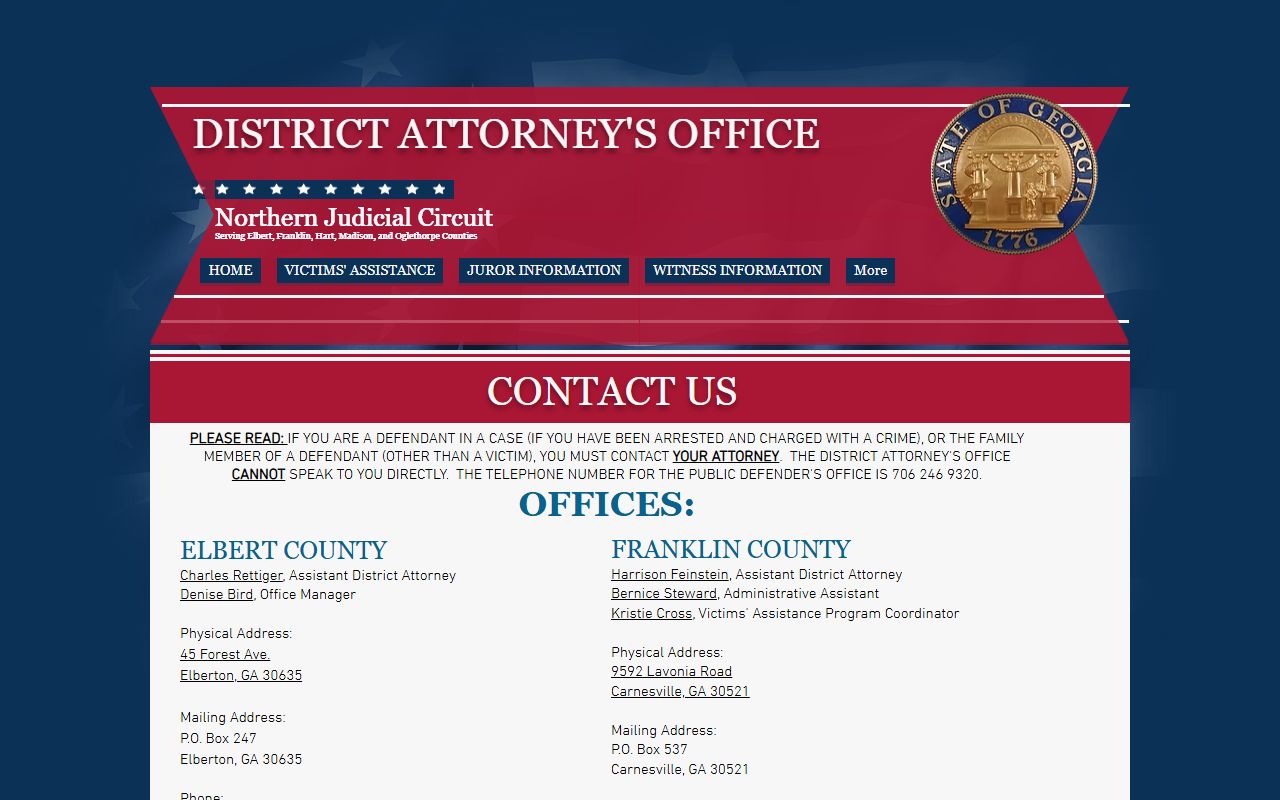
Use DA contacts for prosecution-office records and victim/witness contact, but use the Clerk of Superior Court for the official criminal case docket and court filings.
The DA's background page identifies D. Parks White as District Attorney. The District Attorney biography page gives circuit-level prosecution context for Oglethorpe County criminal court records.
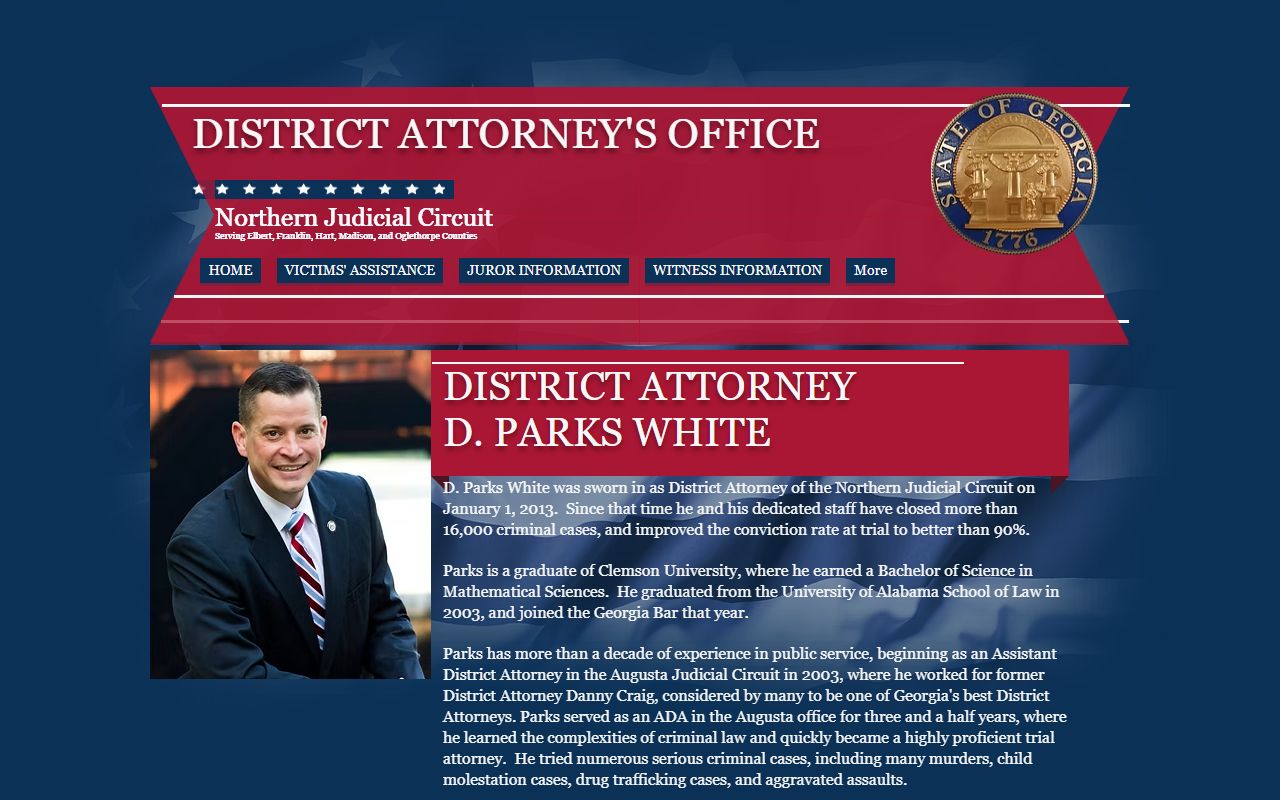
Prosecutor background does not determine a case outcome; the docket and orders show what happened in court.
For appointed defense, the Georgia Public Defender Council lists Amanda Grantham as Circuit Public Defender for the Northern Circuit. The office serves Elbert, Franklin, Hart, Madison, and Oglethorpe counties from 461 Cook St. Ste J, Royston, Georgia 30662, with hours Monday-Friday, 8:30 a.m.-5:00 p.m., phone 706-246-9320. The Northern Circuit public defender page confirms those regional defense contacts.
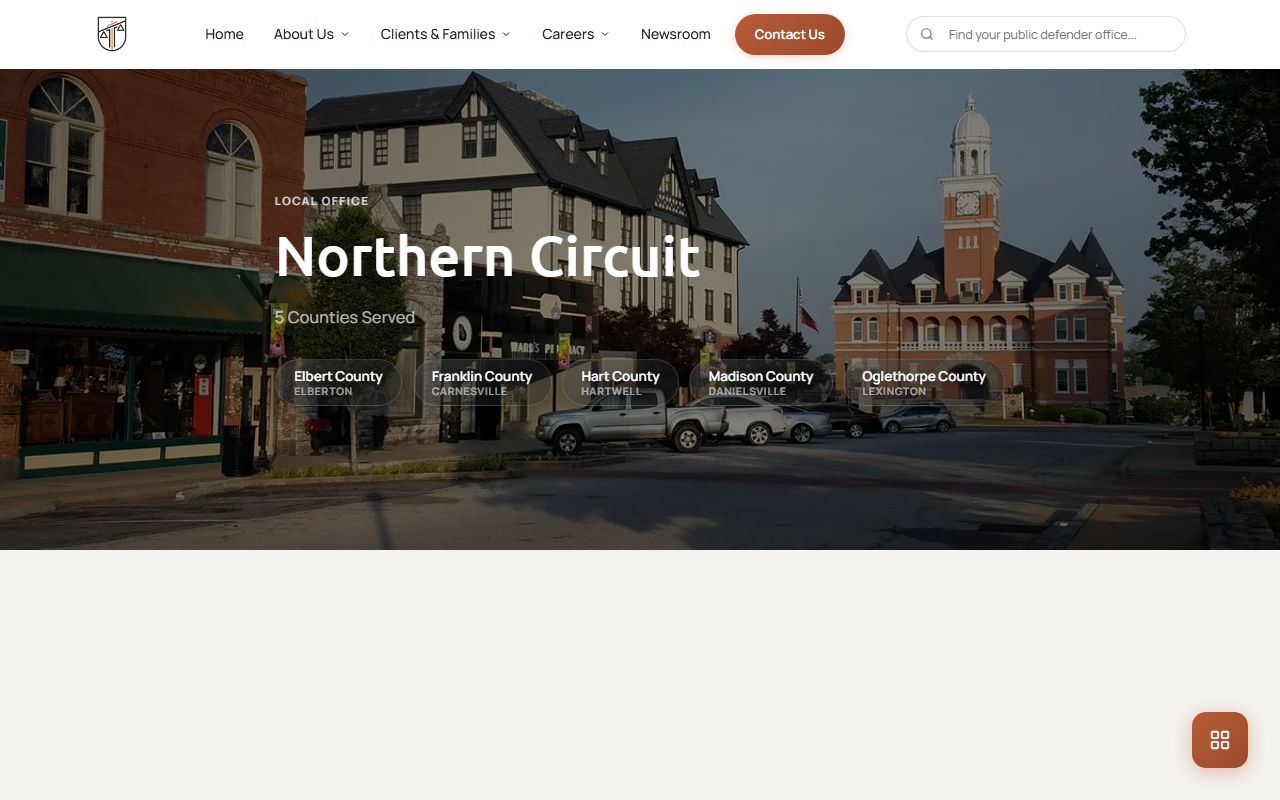
Public defender contact information helps defendants locate counsel resources, but it is not a criminal docket search system.
Charges vs Convictions
A charge is an allegation filed or pursued in the criminal process. A conviction is an outcome after a guilty plea, verdict, or other adjudication that results in guilt. Oglethorpe County criminal court records can show both charged counts and final results. A record can also show charges that were amended, reduced, dismissed, or not prosecuted. Read each count separately rather than treating the first charge line as the final result.
| Charge | Conviction | |
|---|---|---|
| Meaning | An accusation or count filed in the case. | A final guilt outcome by plea, verdict, or qualifying adjudication. |
| Timing | Appears early and can change during prosecution. | Appears at disposition or sentencing stage. |
| Record Risk | May remain visible even if later dropped or dismissed, unless restricted or sealed. | Often appears with sentence, probation, costs, or restitution. |
| How to Verify | Read the docket, accusation, indictment, and amendments. | Read disposition and sentencing entries for each count. |
Read Dispositions and Sentences
Disposition entries should be read count by count. One count can be guilty while another is dismissed. A plea may resolve the case without trial. A nolle prosequi entry means the prosecutor declined to proceed on that charge at that time. A dismissal is not the same as an acquittal, and a reduced charge may explain why the sentence does not match the first arrest or booking charge.
Sentence entries may list jail time, prison time, probation, fines, court costs, restitution, community service, treatment terms, no-contact orders, or special conditions. Probation conditions and revocation entries can add later docket activity after the original sentence. If custody status is the question, use the Sheriff's jail search for current county confinement and GDC for sentenced state prison custody. A court sentence and a custody location are related but not the same record.
Note: For employment, licensing, immigration, or legal filings, get a certified clerk copy.
Sealed vs Restricted Records
Georgia commonly uses the term record restriction for eligible criminal-history limits. The GBI record-restriction resource cites O.C.G.A. 35-3-37 and explains that the process differs depending on the arrest date. For arrests after July 1, 2013, the person generally contacts the prosecutor. For arrests before July 1, 2013, GBI says the person applies through the arresting agency. A court order may still be needed in some situations.
| Sealed | Restricted or Expunged | |
|---|---|---|
| Core Idea | A court limits access to the case file or portions of it. | Georgia record restriction limits public, non-criminal-justice access to eligible criminal-history records. |
| Where to Start | The court that holds the file, often Superior Court for felony matters. | The prosecutor for post-July 1, 2013 arrests or the arresting agency for older arrests, per GBI guidance. |
| Public View | Hidden or partly redacted depending on the order. | Limited from public criminal-history access when approved and processed. |
| Limits | May not block every agency record. | Does not always erase every court, prosecutor, law-enforcement, or internal agency record. |
Public Access to Criminal Records
Public access starts with Georgia's open-records framework, but criminal court records are not all public in the same way. The Georgia Attorney General Open Records Act publication includes O.C.G.A. 50-18-70 et seq. and O.C.G.A. 50-18-71. These provisions support inspection and copying of public records unless a law or court order exempts them. Criminal dockets and many filed court records are public, but juvenile, sealed, restricted, and active-investigation material may be withheld or redacted.
Key Statutes:
O.C.G.A. 50-18-70 et seq. supports public access unless a law or order closes the record.
O.C.G.A. 35-3-37 governs Georgia criminal-history record restriction for eligible records.
Background Check Considerations
A casual criminal court records search is not the same as an FCRA-compliant background check. Court dockets may be incomplete, delayed, restricted, or missing final disposition details. A booking record may show an arrest without showing the court outcome. A court record may show dismissed charges as part of the timeline. For regulated decisions such as employment, housing, credit, insurance, or tenant screening, use lawful consumer-reporting channels and verify records with the originating court.
Important: This website is not a consumer reporting agency and cannot be used for FCRA-regulated decisions.
Restricted Oglethorpe Criminal Records
Restricted criminal court records can include juvenile delinquency files, sealed criminal filings, restricted criminal-history records, mental-health related material, personal identifiers, active warrants, and investigative records. Active warrant information may be withheld if release would compromise law enforcement. Juvenile records should not be expected in ordinary public lookup, even when the Clerk of Superior Court also manages Juvenile records.
For a restriction request, identify the arrest date, arresting agency, prosecutor, court, disposition, and case number before contacting an office. In Oglethorpe County, post-July 1, 2013 restriction issues may involve the Northern Judicial Circuit District Attorney. Pre-July 1, 2013 arrests may start with the arresting agency, such as the Sheriff's Office or another police agency. If a court order is needed, the court file may be in Superior Court or Magistrate Court depending on the matter.
Clerk of Superior Court
111 West Main Street
Lexington, GA 30648
Mail: P.O. Box 68, Lexington, GA 30648
(706) 743-5731
Monday-Friday, 8:00 a.m.-5:00 p.m.
DA Open Records
Hope Cobb, Chief Investigator
P.O. Box 515
Hartwell, GA 30643
706-376-3128